
Overseas manufacturers
Upload formulations in your own language to assess Chinese requirements during product design and identify potential compliance issues.
Check compliance before shipping.
Import with greater confidence.
Digital and intelligent public services
for imported food compliance.
Imported Food Services
Anticipate compliance risks.
Food imports face demanding compliance requirements, frequently updated standards and multiple regulatory steps. Compliance oversights can lead to cargo delays at port or even return shipments, making compliance a shared challenge across the industry.
To help businesses anticipate compliance risks and address shared industry needs, the China Chamber of Commerce of I/E of Foodstuffs, Native Produce and Animal By-products (CFNA) provides Imported Food Services (IFS), delivering digital and intelligent public services for imported food compliance. The IFS platform project is built in cooperation with Chengli Supply Chain Group, with technical research and development undertaken by its wholly owned subsidiary, Shanghai Chengzhi Yunshu Information Technology Co., Ltd.
IFS moves compliance pre-checks from after arrival to before shipment, covering the full journey of imported food from overseas factories to Chinese shelves.
Upload formulations in your own language to assess Chinese requirements during product design and identify potential compliance issues.
Use trade data and product-by-product pre-checks before sourcing to screen out risky products and reduce the chance of one non-compliant item holding up an entire container.
Identify the appropriate food category and applicable standards, then generate Chinese labels to reduce repeated rework and losses from returned shipments.
Check products before listing to reduce the risk of complaints caused by labeling issues.
Specialist agents working together,
cross-checking complex judgments.
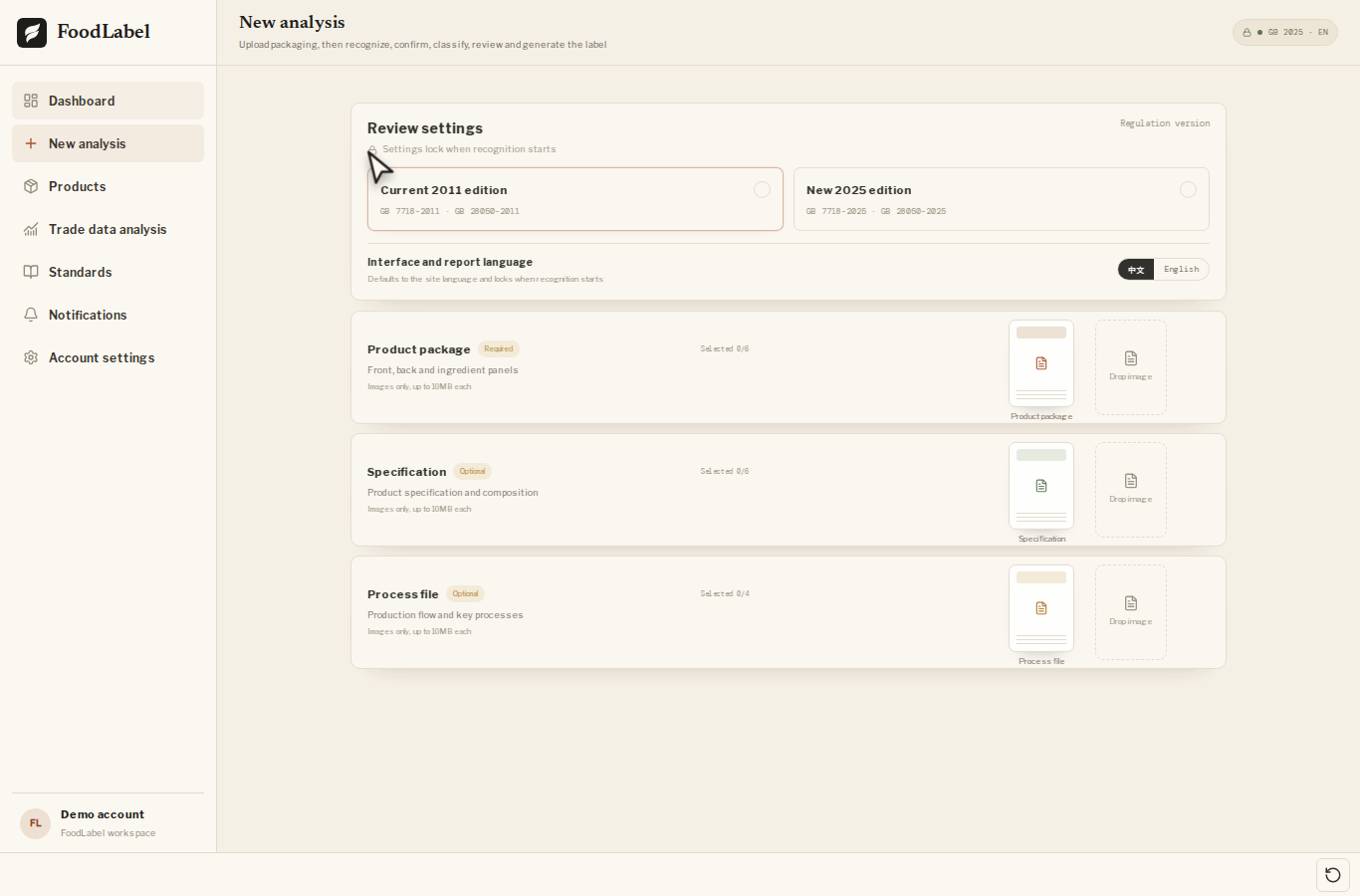 PRODUCT DEMO
FoodLabel, the platform's core system, uses cutting-edge AI and a collaborative multi-agent architecture. Specialist agents work together and cross-check findings to address complex professional judgments such as food classification and ingredient identification.
The system analyzes ingredients individually and breaks down compound ingredients layer by layer to identify their components and labeling requirements. Once interpreted by experts, new regulations are incorporated into system validation rules to keep assessments aligned with the latest standards.
Identify product characteristics and categories
Map ingredients to standardized Chinese names
Review components and labeling requirements layer by layer
Analysis and label drafts require professional review and do not replace regulatory approval.
From document recognition and standards review to Chinese labels, supported by trade data and one-to-one expert assistance.
Upload packaging images and formulation documents for automatic identification and extraction of key information. Ingredients whose customary names differ significantly from standardized Chinese names can also be identified and mapped to the names used in Chinese standards.
Discuss this serviceReview each item against the food categories and standards applicable to the product's actual characteristics. Compliant findings cite the regulatory basis; non-compliant findings identify the relevant provisions and specific reasons.
Discuss this serviceSeparate entry points for the current GB 7718 edition and the new edition taking effect in March 2027 help businesses prepare for the transition.
Discuss this serviceWork with multiple source languages and generate Chinese labels directly.
Discuss this serviceQuery imported food trade data to understand category imports and market trends, informing product selection and market planning.
Discuss this serviceRefer complex questions for expert review, with one-to-one support for compliance interpretation and final label preparation.
Discuss this serviceQuery imported food trade data to understand category imports and market trends, informing product selection and market planning.
Illustrative data · Not live statistics
HS 04090000 · Example period: Jan–Dec 2025
One commodity, two views of its market mix
| Market | Value | Share |
|---|---|---|
| New Zealand | 1,200 | 60% |
| Australia | 500 | 25% |
| Russia | 200 | 10% |
| Other | 100 | 5% |
New Zealand accounts for 60% of import value in this example. Compare quantity as well to understand the market mix.
Through IFS, CFNA brings industry partners together to provide more professional and accessible compliance services for food import businesses.